London,
UK: From the
ingredients in everyday foods to the materials used in soaps, candles,
cosmetics and renewable fuels, commodity supply chains influence far more of
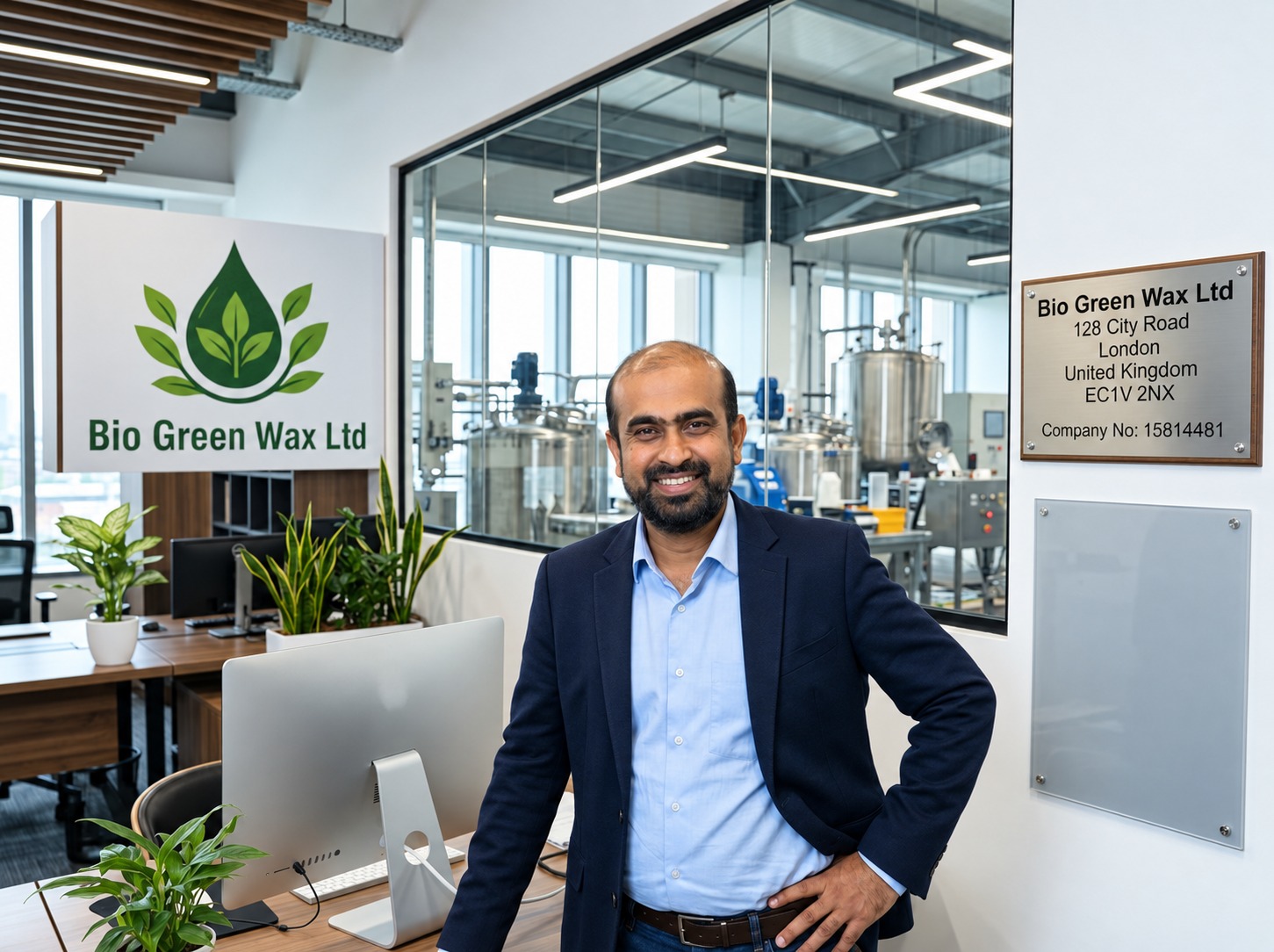
daily life than many people realise. Through Bio Green Wax Ltd and Palm Oil
Economics, Umesh Shankara Gowda is working to make those supply chains easier
to navigate, combining industry knowledge with technology and more accessible
information.
Gowda, a
Director of Bio Green Wax Ltd and Bio Greenware Ltd, works alongside his
business partner, Hantash Najam, a fellow Director of Bio Green Wax Ltd.
Together, they are developing the company’s specialist brands and international
supply network, bringing commodity sourcing, business operations and technology
into a more connected approach to serving customers.
Building
the Foundations
Before entering
this business, Gowda spent more than a decade in the software industry. That
experience continues to shape his approach to commodity supply, particularly
the opportunity to improve communication, organise information and reduce
repetitive work.
Bio
Greenware Ltd, established in 2020, provided the foundation for the subsequent
development of Bio Green Wax Ltd in July 2024. The newer company brought a more
specialised product focus and modern digital outreach, drawing on more than 25
years of combined leadership experience.
Headquartered
in London, the business works through an international network spanning the UK,
India, UAE and Indonesia. Bengaluru supports sourcing and quality control,
Dubai connects the business with the Middle East and Africa, and Jakarta
supports sourcing relationships in producing markets. Understanding a buyer’s
requirements and finding an appropriate supplier depend on these relationships,
alongside product knowledge and practical experience.
Six
Specialist Brands
What began with
oils, fats and waxes has developed into six specialist brands, each presenting
a focused offering for its industry:
- Bio Green Wax
:covers natural, plant-based, industrial and petrochemical waxes,
including carnauba wax, for applications such as candles, cosmetics, food
coatings, adhesives, paper and printing.
- Bio Green Oils and Fats (https://biogreenoilsfats.com)
focuses on
edible oils, specialty fats, palm and soy products, and their derivatives.
- Bio Green Chemicals serves industrial and specialty
chemical requirements across manufacturing and other processing
industries.
- Bio Green Fuels (https://biogreenfuels.com)
specialises in
biofuel feedstocks and materials for renewable fuel production.
- Bio Green Foods (https://biogreenfoods.com)
supplies
ingredients and additives for food and beverage manufacturers.
- Bio Green Oleo (https://biogreenoleo.com)
focuses on
oleochemicals, including fatty acids, glycerine and derivatives used in
soaps, personal care, lubricants and industrial products.
All six
operate under same leadership and the company Bio Green Wax Ltd,. Their
distinct identities make the range easier to explore while clearly identifying
the company behind each website and supply relationship.
The
approach combines specialist product knowledge with industry expertise.
Customers across food, cosmetics, pharmaceuticals and industrial manufacturing
may encounter similarly named materials, but the required grade, purity,
packaging and supporting documents can differ substantially. The starting point
is therefore the customer’s intended use, not simply the product name.
Clarity
in Sourcing
The business was
built around an opportunity to make commercial discussions more informative. A
quotation alone does not tell a buyer whether a material is suitable, how its
origin has been documented or what the delivery terms include.
For palm
oil, the company’s offering includes RSPO Segregated, or SG, supply where
available and supported by the appropriate documentation. This means oil from
certified sources remains separate from non-certified oil throughout the supply
chain, although certified material from different sources may be combined.
Bio Green
Wax also supports EUDR readiness by coordinating origin, traceability and
due-diligence information for applicable European requirements. RSPO
certification can provide supporting evidence, but it does not replace the
separate checks required by the EU Deforestation Regulation.
For
renewable-fuel customers, sourcing options include ISCC-EU-certified feedstocks
where the selected supplier and supply route support the required
certification. Across the wider catalogue, assurances must relate to the
particular product, source and transaction rather than being assumed from a
logo on a website.
The company
reports achieving an ISO 9001:2015-certified quality management system and RSPO
membership during its first year of trading. These are distinct from
certifications held by individual suppliers or manufacturing partners, whose
documents must be checked for their current scope and relevance. Its published
certification information acknowledges that some certificates belong to
partners.
Technology
That Fits
Gowda remains
directly involved in developing the systems supporting the business. With
AI-assisted coding tools, he can turn practical requirements into customised
software more quickly, building on his earlier software experience and his
enjoyment of hands-on development. The team understands its own daily work,
allowing it to design tools around customers’ questions, suppliers’ information
and the checks needed before an order proceeds.
The
company’s internal systems include customer and supplier records, AI-assisted
sales tools, content management, translation, document automation and
round-the-clock automated monitoring. A shared technology foundation supports
the six brand websites while allowing each to retain its own products,
presentation and industry context.
Supplier
information provides a practical example. Catalogues and brochures can be
connected to relevant products, allowing authorised staff to see available
sources from a product’s administration page. More than one supplier can be
associated with a product, while commercially sensitive details remain outside
the public catalogue.
The
websites also support multilingual content, with an administrative
synchronisation process for translating new or updated English information.
Deployment checks, backup validation and testing are intended to keep the
expanding catalogue consistent and dependable. Automation supports the team; it
does not replace the judgement needed to assess suppliers, approve
specifications, confirm prices or agree commercial terms.
Understanding
Palm Oil Economics
Palm oil is the
world’s most widely consumed vegetable oil, representing roughly one-third of
global vegetable-oil consumption. Used in foods, cooking oils, soaps, cosmetics
and biofuels, it is an important internationally traded commodity whose price
movements affect many industries.
Palm Oil Economics extends the business’s approach
into market information. Co-founded by Umesh Shankara Gowda and Hantash Najam,
with Najam providing the founding backing, the platform brings together
information that buyers, traders and suppliers might otherwise need to gather
from numerous sources.
It combines
regularly updated crude palm oil price benchmarks, historical data, market
dashboards, news briefings and information from the Malaysian Palm Oil Board,
or MPOB, and other international sources. Users can explore how production,
stocks, exports, weather, energy prices and government policy influence the
market.
Much of the
information gathering and preparation of updates is automated with AI, while
news drafts require human approval before publication. Its practical tools help
users compare offers in a common currency, estimate how freight affects the
total delivered cost and compare entered specifications with reference grades.
A buyer can move from understanding the market to defining a requirement and
making a sourcing enquiry.
The
platform also provides an experimental seven-day price outlook and a public
forecast scorecard. Showing how predictions compare with subsequent outcomes
allows users to assess performance, including weaker results. Longer-term
uncertainty is presented through ranges rather than a single target price.
Market
information remains freely accessible, supported by commercial sourcing
activity through Bio Green Wax and its partners. That relationship is
disclosed: benchmark prices and model estimates provide context, but they are
not binding quotations or guarantees of future market movements.
A
Worldwide Ambition
With the six
specialist brands already established, the next stage is to strengthen their
product information, supplier coverage and customer service. The ambition is worldwide,
combining deeper relationships in existing markets with connections to new
buyers, manufacturers and producing regions.
Further
priorities include supporting EUDR-ready supply where relevant, developing Palm
Oil Economics as a daily source of market information and exploring how similar
tools could support other commodities.
For Gowda
and Najam, the wider ambition is to bring industry expertise, technology and
stronger business networks closer together. As a young company, Bio Green Wax
has the opportunity to build modern ways of working from the outset, while
recognising that lasting trust depends on dependable service and well-supported
claims.
The aim is
to become a knowledgeable, connected supply partner: helping customers find
suitable materials, understand their options and build relationships that
extend beyond a single transaction.